10. 6th August 2016 Sharon’s Theory of the Mind

There are plenty of big fat books about how the Mind works but if you want something short and unscientific please read below.

My study is based on one cognitively inept person (ie me) observing other people’s behaviour and trying to work out what the hell is going on. Sharon’s Theory states that there are Three Elements of Mind – Cognition, Intellect and Soul[1].

1.Cognition

Cognition is made out of many different cogs (I guess that is why it was termed that way).  All of the cogs play a part –  Attention/ awareness, Planning, Problem Solving and Decision-Making (and other ones that are presumably in all the big fat books about how the mind works) and are somehow all linked together in a mysterious chain reaction and if, as is common, one of these mechanisms  fails to work it can create problems for the other  ones.  The cogs never work perfectly all of the time (that’s just part of the way the system works) and sometimes one part of the system has to overcompensate when another fails, or is having an off day, but if one cog is broken then this creates problems for the whole system. Here’s Sharon’s very simple explanation of the main mechanisms.

  1. a) Awareness

As we walked down the street my daughter notices some scaffolding on a house and said ‘That wasn’t there yesterday’. There are hundreds of things going on in our street – the rain clouds in the sky, the neighbour who is looking a bit sad walking down it, the house whose window is open on a freezing cold day . How did my daughter know for sure that the scaffolding wasn’t there yesterday?  When she walks down the street she might be thinking about what’s going on in her day, how her brother is annoying and what’s for dinner.  How out of all the other things what are going on in the street , as well as what she is talking to me about and what she is thinking about notice the scaffolding.  Its magic is all I can say. It’s a magic that seems effortless but allows those with it to conduct their lives day-to-day. That magic allows the brain to filter out all the information around her and remember any changes that occur.

  1. b) Processing

Processing is 100% taken for granted by 99.99% of the population but is quite fascinating to observe. A husband asks a wife (or vice versa) a simple question eg ‘I want to go out on Thursday.  Is that OK?’ And that provokes seemingly millions of questions in the wife’s mind eg ‘Am I doing anything on Thursday night?’ ‘What time is my husband going out?  Does he need dinner?  Does my husband’s going out mean that there are logistical issues with the kids’ after-school activities?’ These lists of questions seem to go on and on and after a bit of thought the wife simply says, ‘That’s fine, but remember that our daughter needs to be picked up from brownies at 7pm’. If you don’t have the processing element in your brain, like me, then the seemingly endless list of questions just doesn’t happen and thus when you are asked this question you reply, ‘That’s fine’ because you have no idea why it wouldn’t be.

  1. c) Memory

Most people think they know all about memory but, may I suggest, that they don’t.

My son tells me every day that he wants his special green cup with his meal.  He knows that if he doesn’t tell me he will get the wrong cup. As part of my research project into my Mind I have observed that most mum’s know this sort of thing by heart and they don’t write it down on a bit of paper ten times and memorise it (like you would for an exam).  And so the fact that mother’s (and some father’s) remember this fact along with millions of other inconsequential things eg knowing what platform to stand on to wait for a train that you have got on ten times before, is a sign that that their memory (and processing) is working and therefore other cognitive processes have a good chance of working as well.

  1. e) Planning, Problems Solving and Decision Making

This is a problem that most mothers (and fathers) have every day:- How will I get my kids to go to sleep tonight?  Some plan their kids bedtime with military precision ‘I’m going to knacker out the buggers, give them a quick meal and then, 1,2, 3, they will not muck me around, – they will be in bed, asleep.’  Others will say – my child likes to stay up late and I am tired and I like their company (and they haven’t got school tomorrow anyway)so I will let them stay up late.   Each parent would have made a lot of decisions in this process and have a natural attitude towards planning and problem solving which, unless they have some sort of deficit like me, they are comfortable with.  However if you can’t plan, problem solve and make decisions your evening could, like me, look like this,  – half way in the middle of putting the kids to bed you remember that the washing needs to be put in the dryer and after coming down stairs you realise that the kids are now watching tv and you have to start the whole process again.

I would argue that without effective cognition, in short, your life is not pleasant – you have no sense of achievement and few real pleasures.  My observation of other people shows me that you need cognition so that you can feel that you are taking an active part in your life.   However, I have observed, that without it, you are still very much human, and still have a mind.

  1. Intelligence

Although people talk about intelligence a lot it can sometimes be a bit tricky to define exactly what it is.  It can sometimes get confused with cognition eg is having a quick wit intelligence because depends upon your speed of processing? Is having good general knowledge intelligence because it depends upon you having a good memory.  However, Sharon’s definition of intelligence is just simply about being able to understand or discuss concepts.  For example, I am a conceptual thinker – I can write this partially interesting blog because I can think conceptually, I have intelligence and it doesn’t really involve me remembering any facts. Likewise a person with lower intelligence can have an excellent memory, processing etc. And a person with either impaired cognition or intelligence, is still very much human.


  1. Soul

Soul (I call it Nefesh) – Without exception, every human has a Nefesh, not matter what their cognitive or intellectual level – it’s just that some choose to access it more than others . I know a 15 year old boy who some people say is a Problem. He won’t eat, he can only speak in words and not sentences ,  he goes to a special needs school and will never be able to live alone in an unsupported environment, let alone form a romantic relationship or get a job (he has autism and other disabilities).  However, just somehow by feeling his presence when I see meet him I see that his nefesh is beautiful and that he is a very special boy and I love him very much.  Everyone around him admires his parents and his grandparents who give to him unconditionally but now I believe that I have learnt a Truth. Those that love you unconditionally do so because they can see beyond the cognition and intellect – that stuff is important – it gets you by day-to-day but those who love you see beyond this – they see the inner you – your nefesh/ your soul – who you truly are and they love you no matter what.

Thus Sharon’s Theory of Mind concludes that human minds are made up of three elements – Cognition, Intelligence and Soul.  Humans have cognition and intelligence on varying levels but all humans have a soul.


In other news – I have decided that when people ask me that question that no middle class woman on benefit s for a mental health condition wants to be asked ie ‘‘What do you do?’ I will say ‘I am involved in a fascinating project into the mysteries of my brain.  For years I have been in a dead end job and have had a very poor quality of life but now I have found out that there could be a way through.  I have had a couple of setbacks, and have just applied for a grant from the Department of Work and Pensions. The project is going forward, but obviously not as fast as I would like it to be.  My family have been very supportive (even if I have driven them a bit nuts) and I am praying that next week I might see the beginning of the end.’

[1] Soul (A Jewish scholar might draw parellels with Binah, Daat and Chochma but that’s a different discussion).

9. 31st July – Benefits assessment

A middle class woman goes to have an assessment for benefits because she has an invisible illness condition. I guess this happens every day – but it is rarely talked about it.

For those of you that don’t know, if you are ill and can’t work you are entitled to Employment and Support Allowance (ESA),  if you are not receiving statutory sick pay the state won’t just take your GP’s word for it and ask you to attend a ‘full medical assessment’[1].

So after an hour and a half wait (they call it ‘overbooking’ – I call it ‘over-overbooking’) I entered the assessment room and was greeted by a doctor – the assessor. The most important thing in the room was the computer. I felt sorry for the doctor and he felt sorry for me. He felt sorry for me because he could tell I was genuine and that I would rather be working than claiming benefits. I felt sorry for him because his job seemed extraordinarily demeaning. Previously, I learnt, my assessor had been an orthopaedic surgeon, but his eyes started to fail him and so he lost his confidence and changed jobs.  As far as I could see, his job involved reading medical notes, asking a list of questions from a computer and doing some very basic health tests (eg ‘Please can you read the letters on the board’, ‘I want to assess your cognitive function – what is 90 takeaway 7?’).  He also wrote a report. However, I felt the most demeaning part of his job was the fact that, at the end of the interview the surgeon, who presumably had a make a few decisions in his previous career, was not deemed suitably qualified to make a decision on whether I was fit to work and therefore could claim ESA.  That decision would go to a bureaucrat called a Decision Maker. As you know I can’t think straight, so the following day I asked myself silly questions like ‘Why can’t a doctor-assessor ask his own originally crafted questions and then make a Decision on whether the ‘customer’ is able to work? ‘Why eas an ex-orthopaedic surgeon asked to asses somone with epilepsy/ mental health problems? Surely there should be ‘mental health assessors’ and ‘specialist orthopaedic symptoms assessors’ and so forth who can specialise in assessing particular health conditions?’. Was a this very nice doctor the best person to assess me? I am obviously too stupid to answer these questions and so I must accept the rather peculiar reality of the cognitively adept world.

———————–

Yesterday I saw a man, dressed in a pink skirt, so short and childlike that it was probably meant for an eight year old and a top that, me being me, I cannot remember the colour of – walking down the high street.  And I felt a huge connection to him – I thought to myself – ‘Isn’t it great, that in this modern age we can so freely express ourselves.’  Even ten years ago that man would probably not have felt comfortable enough to walk down the road such as he was – transsexuals were simply hidden from view and rarely spoken about.  But in our open society it is possible, and in some areas – even acceptable, to dress openly in this way without being lynched.  And today I can express myself through a blog, telling family and friends how if feel because they could not see it if they just looked at me.  Ten years ago only newbies to the tec world would have written a blog and it was certainly not acceptable to write so freely and openly about mental health issues.  So I am grateful that the modern age allows me, and this man that I do not know, to be able to express ourselves in the way that we want to.

————————-

In other news – I am still waiting upon my neuropsychiatrist getting a second opinion.  He is going to be away for much of August, so it is a waiting game.  I have found research that says that epileptiform activity (which is what I have) can have a large impact on cognitive function even if the patient does not have seizures.

The result of my hair test has come in!!!! I had a phone call with the naturopath who explained to me what my hair test said. I can’t remember the details –there was something about a lack of cobalt and lithium (and yes I did try to write down what she said  – but I have lost the notepad and, in any case, the notes don’t make much sense).  She has got to check that there are no interactions with my antiepileptic medication and will get back to me with a detailed email explaining what minerals and supplements I need to take.

Next week I attend a Personal Independence Payment Assessment (the old Disability Living Allowance) interview – lucky me!!!!

[1] See https://www.gov.uk/employment-support-allowance/eligibility for more information

8. 25th July 2016 Children’s Mental Health

All of my entire life experience has led me to believe that my children’s mental health is more important than their physical health and their ability to do well at school – if they are resilient then they might find it easier to cope with whatever life throws at them – be it failure at exams or poor physical health.

So, how, I often wonder, can we improve our children’s mental health at school? Well for those of you who haven’t read any of my other blogs, you might be surprised to learn that I have come up with one idea that might help (for those of you that have read one of my other blogs you won’t be surprised).

I believe that one of the most important things that Ofsted (the government organisation that audits educational establishments) can do can to improve the mental health of our children is to start measuring the number of hours teachers work in schools.  Now Sharon, you might ask, have you lost the plot?  What has this got to do with my children?  So let me explain my rather peculiar logic.  My little search on Google (who else?) told me something that I already knew – that teachers are overworked. However but it’s always a good idea to throw in a few stats here and there so that people believe you.  The search said that 84% of teachers have suffered some sort of mental health problems in the last two years[1] and another survey found that on average teachers work 48.1 hours per week with one in five working 60 hours or more[2]. So basically you are almost guaranteed that your child’s teacher is some emotional wreck (I think what I really mean is stressed) and this person is also supposed to be a role model for your child and influence their behaviour. That’s not good for your child. Plus also it means that it is difficult to recruit teachers which adds extra stress onto everyone one else at school.  So I propose that if Ofsted find the teachers are working more than 50 hours a week the school is closed down (OK, that is a bit extreme, but they should at least report it and it should be taken into account when the school is assessed).  OK , this sounds good Sharon, you might say, but how can teacher’s reduced their workload? Well, it’s simple – just cut of a lot of all the administrative stuff that is a complete waste of time and energy and doesn’t benefit the children.  I am sure this could be achieved by getting a few teachers in a pub for the afternoon and they would surely come up some good ideas.  However, in the interest of fairness, let’s spend a couple of million pounds on the exercise, have a few special committees, consult with everyone from Policy Institutes in Brussels to elderly people who don’t have kids in and draw up some plans.  My starter for one would be to get rid of SATS (standardised tests for primary school age children).  I am confused most of the time, but I have thought about this several times and I am still not sure why kids do them.

I realise that this might not resolve all of children’s mental health problems – more therapists in schools, less pressure on foe exams, improving support to children with neurological problems such as ADHD, dyslexia and Asperger’s Spectrum Disorder, could obviously help but we must view children’s mental health (and indeed teacher’s) in the context in which they are set and that therefore reducing the burden on teacher’s could really help the children that they teach.

And now, to update you on my very own health problems:  My hair is at this moment being analysed in a lab somewhere in Germany.  It’s in a white envelope with my name, address, and passport number.  If anyone happens to be travelling to Germany and sees it, please say hello from me. The results of these tests will let me know if I should have more vitamins or minerals to improve my health.

The doctor at the Epilepsy Hospital has spoken to my London based neuropsychiatrist and is going to seek a second opinion of the results that I got from my stay. This is the kind of doctor that everyone needs – he is prepared to go the extra mile and realises when he can’t help and then knows someone who can.

PS I really do hope that you understand that I have the ability to be tongue in the cheek sometimes (some people don’t get my humour). I do strongly believe that 99% of teachers are doing an excellent job, under difficult circumstances, and that whatever strain they are on they try not to show this to the children that they teach.  However, as I said, I do think that reducing the burden on them will help the children in the long run.

[1] 2016 https://www.tes.com/news/school-news/breaking-news/eight-10-teachers-have-had-mental-health-problems-and-workload-blame  (Educational Support Partnership)In 2017 75% says that they had experienced physical or mental health issues because of there work and https://www.educationsupportpartnership.org.uk/resources/research-reports/2017-health-survey

[2] Education Policy Unit report – https://epi.org.uk/report/teacherworkload/

7. 18th July 2016 -Mothering whilst ill

I am not the mother I want to be, but I know that I am not alone in thinking this.

As an example of my unmotherliness, I will explain to you what happens when my children come home from school. My eight year old says, ‘I want to watch tv – where is the remote control?’  Me: Spend 20 minutes trying to find it – I feel guilty because I probably lost it. Think to self, ‘I need to make dinner.  What shall I make?  Don’t know’.  ‘What would you like for dinner?’ I ask my five year old, ‘Pasta with tuna,’ he says.  Think to self, ‘Good plan – we have plenty of time to make that.  I will go and put washing on first because I haven’t done that today.’  Go upstairs to get washing. Think to self, ‘What am I doing upstairs?’ Not sure.  See three year old taking all the wipes out of the packet. ‘Why are you making a mess? Let’s go downstairs’. Take daughter downstairs and when at the bottom think to self, ‘I forgot the washing. I will go and get it.’ Go upstairs to get washing.  Me to self, ‘Must make dinner.’  My son says, ‘I am hungry!!’  Me: Feeling guilty that I still haven’t started making dinner,  ‘Have a yoghurt’, I say (only latterly so I realise that this will mean that he will not be hungry for dinner).  Put pasta on – Not sure how much to put in saucepan so use half the packet. Put washing in the machine. Fifteen minutes later pasta is overcooked and I call children in. Elder daughter starts to put mayonnaise in tuna because she likes it with a very specific amount of mayonnaise which I don’t understand. ‘Need to clear breakfast counter,’ I think – children cannot eat from it with that much mess. My son says, ‘I will get the glasses,’ (this is his favourite job). Me to self, ‘What do I need to do now? Oh yes get – Knives AND forks and serve youngest two good on plates which will fit their meal.’ And so it goes on.

So for all of you whose meal times don’t look like this – Kol akovod (well done) – I am in awe of you (and before you suggest it – writing a list of the 25 things that need  to be done when the kids get back from school does not help).  You have the gift of memory, processing and strategic thinking.  It turns out, I realise now, that strategic thinking is not just something that management consultants do.  Almost everyone does strategic thinking as a result of processing the information around them. It helps them to be organised and make on-the-spot decisions about inconsequential things.  If you can’t strategically think and your IQ is at reasonable level – life sucks.

So I am not the mother I want to be – I want to be present with my children, to feel that in–the-moment connection, I want to be a strategic thinker who understands what is best for my children and am able to prioritise their individual needs. I want to be the solid rock that they can count on to help them along their way. But right now I can’t be that person. Neurologically it is not possible.

However, as I said, I am sure I am not alone in not being the mother I want to be.  There are probably millions of other mothers who are in my position but they just don’t announce it on Facebook! (a very silly thing to do!!!).  So for all those who are going through a tough time – whether you are, bipolar, an alcoholic, having an acrimonious divorce or have cancer –  but-really do want to be a good mother (or father), here is a list of the benefits your children can get from your imperfect situation.  Your children:

  1. Have a much better sense that life can sometimes be hard and is not always the way they want it to be.
  2. Might have to fend for themselves a little bit more than other kids. If they really want something they have to go get it themselves otherwise it might not happen.
  3. They learn sometimes they don’t get what they ask for and that is OK

And in my case, which might not, unfortunately, apply to everyone, they also:

  1. Realise that if you are open about your problems other people often show kindness

Obviously if you are going through a difficult and trying time and think this list is a load of crap then I totally get it. But if you liked the list, I’m glad it helped you.

NB I made two factual errors in last week’s blog which I would like to correct.

  1. Firstly I said that 300 people had looked at my blog. However, due to me being confused 100% of the time I got the number wrong. Nevertheless, the data implies that most of the people I know are aware of my problems.   That’s the way it should be because if I had a physical problems most of my friends would know about it.
  2. Sadly, FedEx are not taking my hair sample to Germany – it was too expensive. The idea of a man coming to pick up my hair in a white envelope and taking it all the way to Germany to be analysed for deficiencies in mineral and vitamins sounded very romantic but it was not to be. However, through Royal Mail tracking services, I can now inform you that my hair sample took the late night flight from Heathrow and is now somewhere in Germany awaiting to be taken to Hersbruck.


6. 11th July 2016 – The conclusion is not what I wanted

And so the plot has a slight twist.  The neurologist came round on Friday morning and said to me (more or less), ‘I looked at the computer to see what was in your head and the computer said ‘no’.  It said ‘No we don’t know what causes your problems – it’s not epilepsy.  So you are going to have to sort it out yourself.’ .’I said, ‘What?’ and she said, ‘Well it’s like this I’m a neurologist. I deal with epilepsy and I the data that we have taken from you this week says that although you are having some epileptic activity it’s not enough to make you feel the way you say you are feeling.  So really it’s not my business anymore.  Go back to your GP and see if she can refer to you to someone else.’  As in all cases like this it wasn’t the computer that I was angry with, it was the person operating it.

And so people have told me –  the result is good – ‘At least you have ruled something out – your epilepsy isn’t the cause of your problems’.  ‘Ok’, I think to myself.  ‘But I have a lot of problems.  I really wanted to rule something in’.  ‘Well then at least you don’t have to have brain surgery,’ they say. But the person with epilepsy knows that medication only helps 70% of people with the condition.  The other 30% are a bit desperate and would try anything, including brain surgery, if they thought it would help them.

Others say – there is Hope.  And honestly, I really do believe in G-d.  I don’t believe there is another way to explain everything.  But really when the going gets tough it is hard to believe.  I want to believe, but it’s hard.

The third thing that people say is ‘Look for the positives’.  This I usually think is a pile of crap because how can you look for something positive if you don’t know what you are looking for.   But in this instance I have found two positives.  Firstly, I met some really good people in Chalfonts.  I have found, over the years, that people who are going through a really tough time are some of the most real and beautiful people I have ever met. And when you are going through a tough time it helps to be near like-minded souls.  It doesn’t need to be a structured therapy session – just having a chat with someone that knows is just really good. And it was good to speak to these people (when I wasn’t stuck in a room) and understand their journeys and to share their pain.

Secondly I have found writing.  I like writing.  I have also had good feedback.  And according to the stats 300 people have read my blogs. I don’t know quite how, or if this is even accurate, but that’s what the stats say. Anyway, writing is therapeutic for me. That’s why there is a new type of mental health recovery programme which implies that if you start up a new hobby you’ll feel better.  If you were raped as a child, you are not going to find art and all of a sudden feel great again.  But I guess what they mean is the art helps ease the pain and improves self-esteem whilst time (or medication or therapy) heals the mind.

So tomorrow, like some weird detective story, I am going to cut a piece of my hair and put it in a white envelope and then a Fedex guy will come and take it to Germany.  This piece of hair is going to get analysed by a German or an Israeli doctor and hopefully they will give me a plan going forward.  It’s an ‘alternative way’ recommended by a friend. But it makes sense because apparently there is more information in your hair about the way you are operating than there is in your blood.

But I am also going to get a second opinion – One of the more helpful doctors from Chalfonts is also going to speak to my doctor in London to see if they can come up with anything new. The last option I have been offered is Cognitive Remediation therapy.  I don’t like the last option. This is a therapy that they give to people with brain damage to see if they can find strategies to work around their problems.

I will let you know what happens.


5. 7th July 2016 Mental Health Manifesto – part 2

Yesterday I presented the quick cheap ways to make the mental health service better.  Today I present two, more expensive ones.


  1. Simplify the mental health system
  2. Train psychiatrists, therapists, social workers and other people involved in mental health services to recognise undiagnosed neurological conditions.


  1. Simplify the mental health system

As I explained yesterday under the current system in the NHS in Hertfordshire, and I suspect elsewhere,  a patient with a chronic mental health problem has to see many (in Hertfordshire it can be up to six) mental health professionals before receiving therapy – and patients have to explain their personal story, who they, perhaps, have not explained to anyone else, to each new person.  If you are a happy person this would make your weary.  If you’re a depressed person just dealing with the system could literally send you over the edge.  However, the private system in the UK doesn’t work that and I think the NHS should copy the private system. In my experience if you want to go private this is what happens: – You go to your GP and you tell them that you are depressed.  If s/he thinks that you need more specialist help she will write a referral letter.  You phone up your insurance company and if you have funding in a week’s time you can be sitting in a psychiatrist’s office (obviously if you haven’t got funding your stuffed, but that’s a different matter).  The psychiatrist is the first, and perhaps only, person that will take a detailed account of your history and s/he decides the best course of action to take eg Do you have a particular diagnosis that needs medication eg schizophrenia, bipolar, an anxiety disorder, Do you need therapy?, What sort of therapy?, Is there a therapist who would be a good ‘fit’ to your particular personality and that convenient for you to get to?  How much therapy is required?  Is the situation desperate – should this person go to hospital? If say the psychiatrist prescribed you ten therapy sessions s\he might see you after that period to assess whether you need more therapy/ medication.  It’s just simple – you see one GP, one psychiatrist and one therapist and ideally you should see the same people on an ongoing basis. Of course, it doesn’t mean that people do not suffer, or die.  Conditions are hard to treat, and wrong diagnoses are made (see point two below). But it does mean that the system is easier to understand and there is less chance of people falling through the gaps.

  1. Train mental health professionals to recognise undiagnosed neurological conditions


Everyone knows the a story of the boy, who is not doing that well at school, whose behaviour goes off the rails, who has a single mother with a full-time job and two other kids from other relationships.  Although the mother loves her son very much, she has a below average literacy level, and she never does homework with him.  In manhood, this boy can go one of two ways – either to prison or on the bright side – have low paid jobs and on and off anti-depressants for the rest of his life (there is of course a the third possibility – that he find a passion like music, which dramatically increases his self-esteem, and although difficult, he works hard to improve his literacy and ends up having a career in music, a loving family and very much enjoys life).  In either of the first two examples the man goes to see a therapist and at the back of her mind the therapist is asking herself, ‘Why is this man depressed?  What made him this way?  I can see that he had a difficult childhood but I think I am missing something’. The man, of course, has undiagnosed dyslexia. The reason that the therapist is asking herself this question is because she has absolutely no training in recognising dyslexia or for that matter any other neurological condition like ADHD, autistic spectrum disorder (ASD), dyspraxia, and indeed epilepsy.  She is trained primarily to listen and to understand personality traits and how people behave in relationships. And as a mental health professional she is not alone in not being able to recognise these conditions – many psychiatrists, in my experience, are not able to recognise them or think that these conditions occur only in children.  Therefore, although the therapist might be able to treat emotional issues that her patient might have, from other experiences in life, she will never be able to address the underlying cause of her low self-esteem because dyslexia isn’t something she is trained to treat.

Rabbi Tatz argued, (get reference) that depression is caused by a lack of achieving your potential.  That is why I believe I got depressed – I knew I was different from other people – but I didn’t know how and I couldn’t explain it to anyone because I didn’t his is why I believe I got depressed. And I am not alone – people with ADHD, ASD, epilepsy etc are just much more likely to get depressed[1] than other people. But if as I did, they go to a therapist, to treat this illness, they are unable to because it hasn’t been diagnosed and they don’t have the skills required to recognise it – let alone treat it (of course the patient could have of issues that a therapist could help with but there will always be a part of the patient that goes untreated),

Thus I believe that all mental health professionals, including therapists, psychiatrists, social workers and even GPs should be trained to spot these neurological conditions so they can refer patients who they suspect have one onto the appropriate professional and receive the appropriate care.

So that’s it Sharon’s mental health manifesto – part two. It’s expensive – but could be cheap in the long run.

PS Sorry if this blog sounds a bit antsy, but for those of you that don’t know I have been stuck in a big brother room for four days with 27 electrodes on my head being videoed monitored so the docs can see if I am having seizures.  Tomorrow I get out – freedom!

[1] https://www.epilepsy.org.uk/info/depression   https://adaa.org/understanding-anxiety/related-illnesses/other-related-conditions/adult-adhd#   http://www.autism.org.uk/about/health/mental-health.aspx

4. 6th July 2016 – Sharon’s Mental Health Manifesto Part 1

The NHS always talks about patient participation.  I don’t think that someone who is on the verge of ending their life would be asked to rate on a scale of one to ten if they feel listened to by their social worker –   but the intention is clear – those receiving the mental health services should be involved in designing and assessing the care that they receive.  My mother-in-law, Karen Ross, MBE, told me that she always thought that to be ill you need to be well. And she is right.  I have a lot of experience of being within the mental health system but when I was ill (in that way) I just didn’t have the strength to try and understand the health system, to chase medical appointments and also to get angry – but articulate – when the system wasn’t working for me.  But now I am not feeling so depressed (just cognitively inept) and in the spirit of patient participation, I present to you my own mental health manifesto, part one – the cheap one (part two tomorrow is expensive).

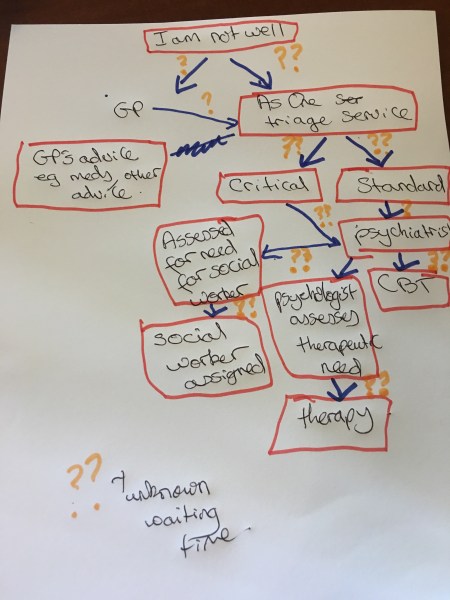
When a patient first visits a GP saying they are depressed they should be given two information sheets – one would have a simple organisational flow chart to explain how the mental health system works in their area and another would detail non-NHS resources that they could turn to, in case, as is 100% likely, their referral doesn’t come through as quickly as they would like.

  1. Organisational flow chart –

After three years in the Hertfordshire Partnership University NHS Foundation (ie the Mental Health Trust) system I am now going to try and explain to you the steps a patient has to take on their mental health journey (although some management consultant is probably plotting to change the system as we speak).  Firstly you have trot off to your GP you say ‘I am depressed’ and if the doc thinks you need more than a tablet s/he will refer you to the As One services.  You can also decide to just skip that bit and phone up As One yourselves. As One then make an appointment with you for a short triage session at their specialist centre (ie a call centre). For those of you that don’t know, there are a hell of a lot of depressed people out there today, and even feeling suicidal is not enough to get you mental health care quickly.  You need to feel that you are going to do the deed in the next ten minutes if you want immediate help.  If you only have the S thought once a week the call centre (maned, it has to be said, by trained therapists and the like) put to the back of the queue.  The call centre then assigns you to one of two services – what I call the Critical or Standard service.  If you are assigned to the Critical Service, about six weeks after going to the GP telling him/ her that you desperately wanting to kill yourself you can finally see a psychiatrist.  You tell them your woes and s/he gives you a tablet and also gives you a nice label eg bipolar, borderline personality disorder, generalised anxiety disorder etc. Sometime after that you might get an appointment to see a clinical psychologist who tells you what type of therapy s/her thinks is best for you (but she won’t be able to tell you what the waiting time to see a therapist is like). And eventually after all these shenanigans you are put on a list to see a therapist.  In between all of this you might also be given a social worker to perk you up every now and then.  So are you with me?  That’s six people (and it could be more) that you have to tell your life story to if you are feeling shit.  I think, it’s much better to be a patient in the Standard group because then you have to wait a bit longer to see a psychiatrist but you are just assigned a Cognitive Behavioural Therapist and you can relax a bit and feel less confused.  Don’t get me wrong, most of people that work in the Service are extremely helpful, caring and work very hard in a particular stressful situation.  But I am sure you will agree with me that an organisational flow chart of how the system works would be useful for each patient, preferably with target wait times for each appointment.

NB – If you think that no-one should have to explain their inner soul to seven different people when you are depressed, then I agree with you.  This will take a lot of extra funding and I will discuss this tomorrow.

  1. The second sheet of paper would have a list of four different types of non- NHS resources that are available to so that patients can be signposted to what can literally be life-saving resources if, as is inevitable their referral takes longer than is expected.
  2. i) Specialist mental health charities

We are blessed in this country to have many mental health charities that can provide excellent support  eg Mind (there’s one in Leeming Road, Borehamwood), the Jewish Association of Mental Illness (JAMI) and many others.  GPs should be fully informed about these services and signpost patients to them if it’s appropriate.

  1. ii) Online support groups.

The NHS has an excellent support portal for people suffering with mental health issues – called the BigWhiteWall – but GPs need to be aware of it and advocate for its ability to show patients that they are not alone and that other going through similar troubles can help them. Facebook also has an array of specialist support groups.

iii) Mindfulness resources.

If you read the literature on mindfulness it says that, if practiced regularly, mindfulness can help you find true inner peace and joy. It might not achieve all of your expectations but it can help.  There are lots of mindfulness apps on the internet (free or paid for) as well as face to face groups – and patients should be given details of them when they first go to their GP (Personally I think that the NHS should have its own free mindfulness app for patients but that’s a different story).

  1. iv) Paid for services

It isn’t really controversial to admit that some people pay for services when they know that the NHS isn’t meeting their expectations. And therefore I think that on this piece of paper should be a list of paid-for mental health services eg registered private therapists listed on the British Association for Counselling and Psychotherapy or the UK Council for Psychotherapists search facility.

So that is the first part of my mental health manifesto. When a patient comes to see a GP – give them two pieces of paper (or to cut costs one double sided-piece of paper).  Tomorrow – part two.

3. 5th july 2016 – An introduction to epilepsy by someone who has epilepsy (ie not a medic or some random person who happens be writing for an internet site).

There are over forty different types of seizures.  The most famous one is the grand mal.  Like the T-rex, it is hard to miss – the sufferer screams, makes very strange movements, and falls to the floor and in doing so sometimes injures themselves eg break their back.  They also lose their memory before and after the incident (for a better description ask my husband, Michael, or my daughter, Gabriella, who have seen me have four).

Let me introduce you two of the less famous ones. Firstly, the partial complex seizure which I saw on Shabbat.  I was enjoying watching Pretty Woman when suddenly I noticed the patient (ie a friend) next to me was having a partial complex seizure – she was sitting perfectly upright but her face had gone all floppy and when you looked at her eyes it was if, her nefesh, her soul, had been removed.  There was nothing there.  She was totally vacant.  Twenty minutes later it was as if nothing had happened – but she couldn’t remember the whole thing.

And then there are absences or ‘petit mal’.  I have absences.  Blink and you will miss them.  Although some people have them for three or four seconds, mine, are less than that. As a child it was taken for day-dreaming.  Whatever type of seizure you have the whole process screws up your brain and can leave you feeling exhausted.

————

I have noticed lately that I don’t do something called metacognition eg Another mother at the school bus stop said to me last week ‘The bus has been very late this week.’ And I thought ‘How do you know that?’  This involves lots of brain processing eg first of all you have to remember if the bus was late yesterday (I simply cannot remember) and then you have to recall the day before that and the day before that and then hey presto some algorithm is pressed upstairs and out comes the answer – the bus has been very late this week.  ‘Gosh’, I bet the other mother would say to me if she was reading this ‘I never even realised that I was doing that’.  And my response would be ‘I also find the neuropsychological mechanisms of the brain fascinating but, for me, this isn’t academics.  This is a painful existence.

My middle son doesn’t like to say the shema prayer before he goes to bed – he finds it boring.  So I ask him to say one thing that he is grateful to hashem for and put in one request. Tonight I am grateful to the nurse who gave me blue tak so I could put the ‘Mummy get well soon’ poster that my elder daughter had drawn on the wall.  It means I can see it all the time and I am very appreciative of the nurse’s simple act.  So, as a suggestion, you, the reader, might decide to be grateful for your metacognitive ability, because living without it isn’t fun.  And my request to Her will be to give guidance to the doctors at the hospital so that they can help me on my journey.

2. 4th July 2016 – Do we really have free will?

2 July 2016 – Do we really have free will / A note on staying in hospital on Shabbat

I like to think that my eldest daughter (aged 8) is mature for her age.  ‘You know sometimes’, she said to me the other day, ‘it seems to me that you just don’t think before you do things’. ‘Yes, I know’, I said ‘that’s why I am going to hospital, so the doctors can find out why that is’.  After all if when I take the drying out of the machine and some of it falls into the pile of dirty washing on the floor and then I wash both clean and dirty clothes in a new cycle and I do this time after time after time, it does look like I am not thinking.  ‘But everyone has control over their thoughts, don’t they mummy?’ she said and I said, ‘I’m not so sure’ and she went away slightly perplexed.  And even for an adult understanding that the truth is we don’t have as much free will over our thoughts and actions as we would like to think is disturbing.  I once met a woman who was beaten up by her husband whilst she was pregnant but she still went back to him.  I also met a man, suffering from obsessive compulsive disorder, previously he was studying to be a doctor, he had a wife and children who he obviously loved very much, but he fervently believed that asbestos was everywhere and couldn’t cuddle them and so slept on the floor – such was his anxiety that asbestos being could be on his bed or on his wife or children (he scrupulously cleaned the floor so he could sleep on it).  Surely if they had enough free will the woman would have left her husband and the man would get back into his bed and study to be a doctor.  Logically they knew that what they were doing didn’t make sense. But they didn’t have as much free will as they would have liked and they certainly couldn’t pull themselves together or snap right out of it – just like I can’t snap right out of my mental state.


Samuel Landau, a rabbi, wrote an article about neuroscience in the Jewish Chronicle a few weeks ago.  Drawing from Rabbi Dessler he argued that we are all at different points on some sort of neuropsychological ladder or axis and we can use our internal resources (and maybe some drugs and whatever other help we need) to ascend or descend it. But we should remember that we are all at a different point to begin with.

Thus for some people it is genuinely harder to pass that exam, to speak kindly about other people or to not take advantage of those weaker than themselves. And for me, I start at a place of impaired cognition and I realise that life has been genuinely more difficult for me than it has for some others.  And sometimes, even trying harder, has not worked. But we all start in different places and I, as many people do, will be trying to use the internal resources that I have to ascend this ladder.


———————-


A note about staying in hospital on Shabbat:


As an observant Jew on Shabbat I cannot use electricity or my mobile phone, use light switches and there is an endless list of other things as well (eg no harvesting of crops). We also have special rituals like women lighting candles to bring in shabbat and saying special prayers over wine. So it has just been Shabbat and over this period I have, more or less I kept to those things.  It was very tempting not to use the electric button to put the hospital bed in a more upright position, but I did not.  However, I am not a saint and I did watch Pretty Woman in the lounge because it was already on and there wasn’t much else to do (strictly speaking this is OK because I didn’t turn on the tv but it isn’t what we would call ‘in the spirit of Shabbat’).  However the main difference about Shabbat in hospital and Shabbat at home is that in hospital it does not have the same qualitative feel, the same awareness that you have put all things aside and are dedicated to spending time with your family and friends, reconnecting and refreshing (although obviously if you feel like complete shit whether at home or in hospital you are still going to feel like complete shit on Shabbat – it isn’t a miracle cure).  The saddest thing for me was that I was unable to light candles.  The hospital were not keen on the idea(!!!) so I asked a rabbi what I could do instead and he said I could switch on an effervescent lamp and say the blessing on that. I did this but of course it wasn’t the same.  Until tomorrow xx


To receive updates of my blogs please go to https://www.facebook.com/groups/371346339966284/

1. July 1st 2016 – epilepsy and me

My eight year old daughter, Gabriella, had choreographed a dance routine with her friend for her school show, ‘Year 3’s got talent’.  They had rehearsed at every available opportunity – at break-time, during playdates and at home by themselves.  They had chosen their own music, decided what they were going to wear and how they were going to do their hair.  I was very proud.  I was more than proud. Gabriella had worked together with a friend in a dedicated way to create something original.  But as I sat there waiting for the show to begin I knew that I wasn’t going to view the dance routine in the same way as the other parents.  Throughout the routine I was asking myself, ‘What aspect of the dance should I be looking at?’, ‘How do I tell whether this part of the dance routine is good or not?’, ‘Is it in time?’, ‘Should I be looking at my daughter’s friend now or should I be looking at my daughter?’  I knew that there was nothing I could do to answer these questions. My mind is a permanent fog.  And then before I knew it – quite literally – the dance had finished.  The mother of Gabriella’s friend had already got up and congratulated her daughter with a cuddle.  I was slow on the uptake and another mother congratulated my daughter before me (not that I blame the other mother – I was slow). ‘Thank G-d I am going to hospital,’ I thought, ‘so that the doctors can understand what is happening with my brain’.  The experience of watching the show was simply too painful for me and I desperately wanted to sort it out.

So here I am at the epilepsy hospital so that they can carry out an intensive assessment.  The theory is that I might be having lots of seizures, where I lose consciousness for a second or two, and I am not even aware of them. This is the hidden face of epilepsy.  As I am learning epilepsy isn’t just about having very obvious clonic tonic seizures which look dreadful, and can cause those having one to injury themselves.  It is also about small millisecond seizures that the person having them might not be aware of.  It is also what happens in between seizures – the epileptiform activity and how that impacts on cognitive function.  This epileptiform activity certainly seems to be impacting on mine – for example I mostly don’t process information (eg my three year old had decided to take off her wet nappy – I also saw that next to the nappy was a pool of water but I didn’t connect the two pieces of information – I didn’t think that the water was urine I thought that it was water), and my memory is very poor (eg if my husband talks about our holiday last year I can remember the fact that we went on holiday but the name of the resort or the details of a particularly day trip that we went on escape me).  But when talking to me no-one would know the difficulties I am facing every minute of the day – indeed this is the hidden face of all mental health illnesses because although I am in immense pain no one (apart from you because I have explained it to you) knows.

However, you will be pleased to know that I am doing 100% better than I was last year when I watched my four year old son perform the Gruffalo show at nursery.  My cognitive function was just as impaired then but I didn’t know that this was the problem.  ‘Why does this show feel boring?’ I asked myself.  ‘I just don’t want to be here’ ‘All the other mums seem to really enjoy watching their child in the show – why can’t I?’ ‘Why am I always like this?’ ‘Oh I think I will just go home and kill myself’.

So starting on Monday, I am going to be in a hospital room for five days and I will not be allowed to come out of it.  I will be wearing sensors attached to my head to measure brain activity, using an EEG, and I will be videoed from all angles.  The idea is that doctors will be able to spot on the video when I am having seizures and measure my brain activity at that point.  And, please G-d, on the basis of those results they will be able to make recommendations as to how to treat my epilepsy.

I will try and write a blog every day – I will be seriously bored (but of course the news is always a drama to watch these days, what with Brexit, the British elections, general political turmoil and of course there is always Wimbledon).  But just to let you know that I might not because I might forget to write.

To receive updates of my blogs please go to https://www.facebook.com/groups/371346339966284/